This is not the story of an aging middle school. This is the story of a repurposed 1918 elementary school that was asked to become something it was never designed to be. Despite multiple additions and renovations, the limitations of the original structure remain—creating layout and infrastructure barriers that cannot be overcome to meet modern educational best practices or the needs of today’s students.
Our schools are the heart of our village. They are why families choose to live here and their reputation was built through generations of shared commitment to providing the best possible education for our children. Protecting that legacy means ensuring our facilities support—not limit—student opportunity.
Why Now?
The Middle School is the oldest building maintained by the district (over 100 yrs old!). It has the most critical infrastructure needs. This includes:
HVAC
Plumbing
Electrical
Fire Alarm and Sprinkler Systems
Building exterior, roofing and windows
Replacing these systems alone would cost at least $21.7M - a significant investment in a building structure that limits learning opportunities for students and creates challenges every day for teachers. Whitefish Bay’s reputation of excellent schools needs more than the minimum of functional infrastructure in a building renovated for learning more than 30 years ago.
Learning Opportunities
Classrooms are significantly undersized and designed for “one to many” learning.
Updated spaces would support interactive, group-driven learning and discovery. Students could collaborate in large and small groups across different disciplines.
Space is limited to provide robust specialized electives.
New spaces for exploring a variety of interests and potential career pathways include maker spaces, art and music rooms, pre-engineering labs, Project Lead the Way space.
Cafeteria is cramped, windowless, and undersized.
A new building can accommodate a larger cafeteria and a two station gym, to promote social connections.
Supervision is challenging due to building layout - creating safety & behavior concerns.
Cohesively designed building allows for non-intrusive observation, promoting independence while maintaining supervision for safety and guidance.
Accessibility is not up to ADA standards.
Being able to plan an entirely new building layout - accessibility can be addressed from the start, ensuring all students can feel included and welcome in our middle school.
Outdoor area is cracked blacktop and no grass.
The new building location allows students to have access to green space (the lacrosse field at Armory park) during the day AND the community access to green space at the current middle school site.
Read the District’s Why Change is Needed document
Why Can’t We Just Renovate The Middle School On the Same Site?
First, it’s important to clarify what “renovating” the middle school would actually mean. In this case, renovation wouldn’t simply involve cosmetic updates or replacing aging systems. To address the building’s core issues, the project would need to both modernize the school’s infrastructure and reconfigure classrooms and spaces to support modern learning. Achieving that would require taking much of the building down to its structural frame (“to the studs”), removing some portions of the building, and adding new sections.
Renovation on the current site is not a cost-effective or comprehensive solution.
Renovating reduces flexibility in updating learning and commons spaces. The existing building cannot structurally accommodate building optimal educational spaces.
New additions would be needed to meet education space standards. These would only add to the non-cohesive layout of the current building. It also removes a large part of the outdoor area around the middle school used by students during recess.
Renovation would cause multi-year disruption to classroom learning. The district anticipates full renovation would take at least 3 years, during which time students would still need to attend school. Logistically, the district does not have space to move these students elsewhere. In contrast, building a new middle school in a new location is estimated to take 18 months with little disruption to current students and teachers.
Full renovation to attempt to meet best standards is estimated to cost just over the amount for a new building, while not fully addressing the current learning challenges.
With costs close to equal, investing in an old structure that would continue to impose challenges to improving our students’ and teachers’ environments is not a forward thinking solution. A new building can solve both infrastructure AND learning environment challenges with the fewest compromises to future generations of students.
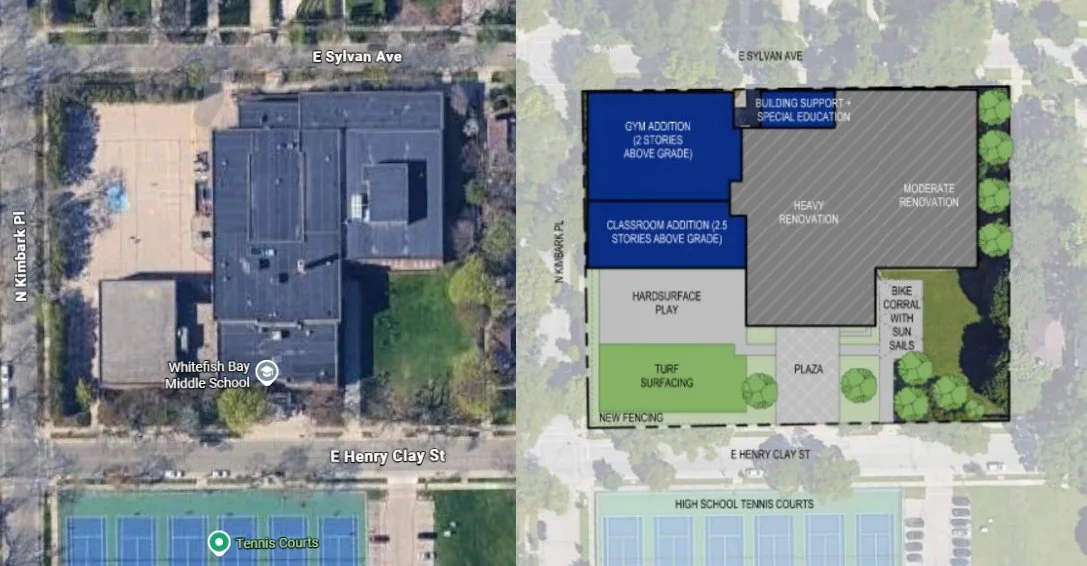
Image above: “Renovate in Place” option presented during facilities planning. This option would involve a mix of building additions, moderate and heavy renovations, and demolition of portions of the existing structure, all while trying to keep the school operational.
Where Would It Go? What happens to Armory Park and the Armory Memorial?
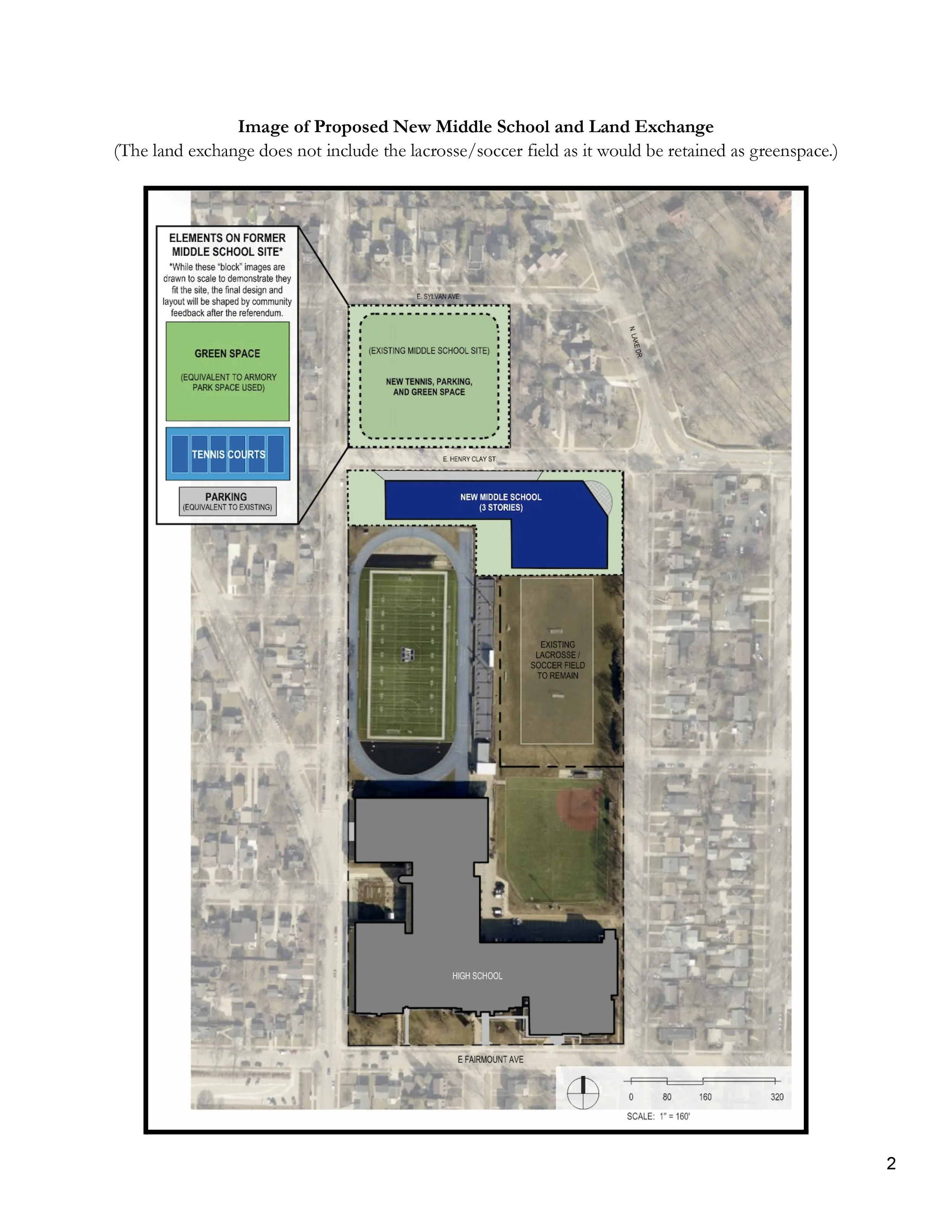
Note: The large greenspace (lacrosse and soccer field) on Armory Park will NOT be touched and will continue to exist if this referendum passes. In addition, the District, the Village, and The Friends of the Armory Memorial have been collaborating on the future of Armory Park even before the option to place the middle school on Armory Park was discussed and they are all are jointly committed to honoring our local history and traditions.
Details of land swap and what will happen to Armory Memorial along with a joint statement between the District, Village, and Friends of the Armory can be seen here.
What Other Options Were Considered?
Due to the landlocked nature of Whitefish Bay - it’s extremely challenging to find an area to build a new building. In addition, the middle school itself is the most landlocked site - making renovations and additions difficult and less cohesive.
The Board considered several options for moving or updating the middle school and they consulted many different sources to evaluate the options. They held discussions with the Village, with Friends of Armory Park, with their architects who have extensive experience with new school buildings.
A review of their options can be viewed in this presentation.
If you’re curious why most of the middle school options presented during facilities planning cost about the same (~$67 million), it’s because all of the options build essentially the same school.
A middle school designed for a certain number of students requires roughly the same square footage and core spaces: classrooms, hallways, lockers, cafeteria, library, gym, music rooms, bathrooms, and offices. When you add those together, the building ends up about the same size regardless of where it’s built, which leads to similar construction costs.
The main differences in price come from where the school would be located: rebuilding on the current site, building near the high school, or building on the Henry Clay site. Each site has different preparation and logistics costs.
It’s also unclear whether the additional logistics of rebuilding on the current site, such as relocating students and teachers during multi-year construction, are fully reflected in the estimate.
What Does The Middle School Look Like Inside?
What’s In a Typical Modern Middle School Nowadays?
Fox Point / Bayside just recently built a new middle school in 2024. It’s a 120,000 sq ft facility to house approximately 400 students. Info sheet here.
This is a pretty standard middle school that focuses on flexible learning environments, safety, accessibility, and easy supervision. While Whitefish Bay’s new middle school will be larger (since we have larger enrollment), it will have similar features as Bayside’s new middle school.
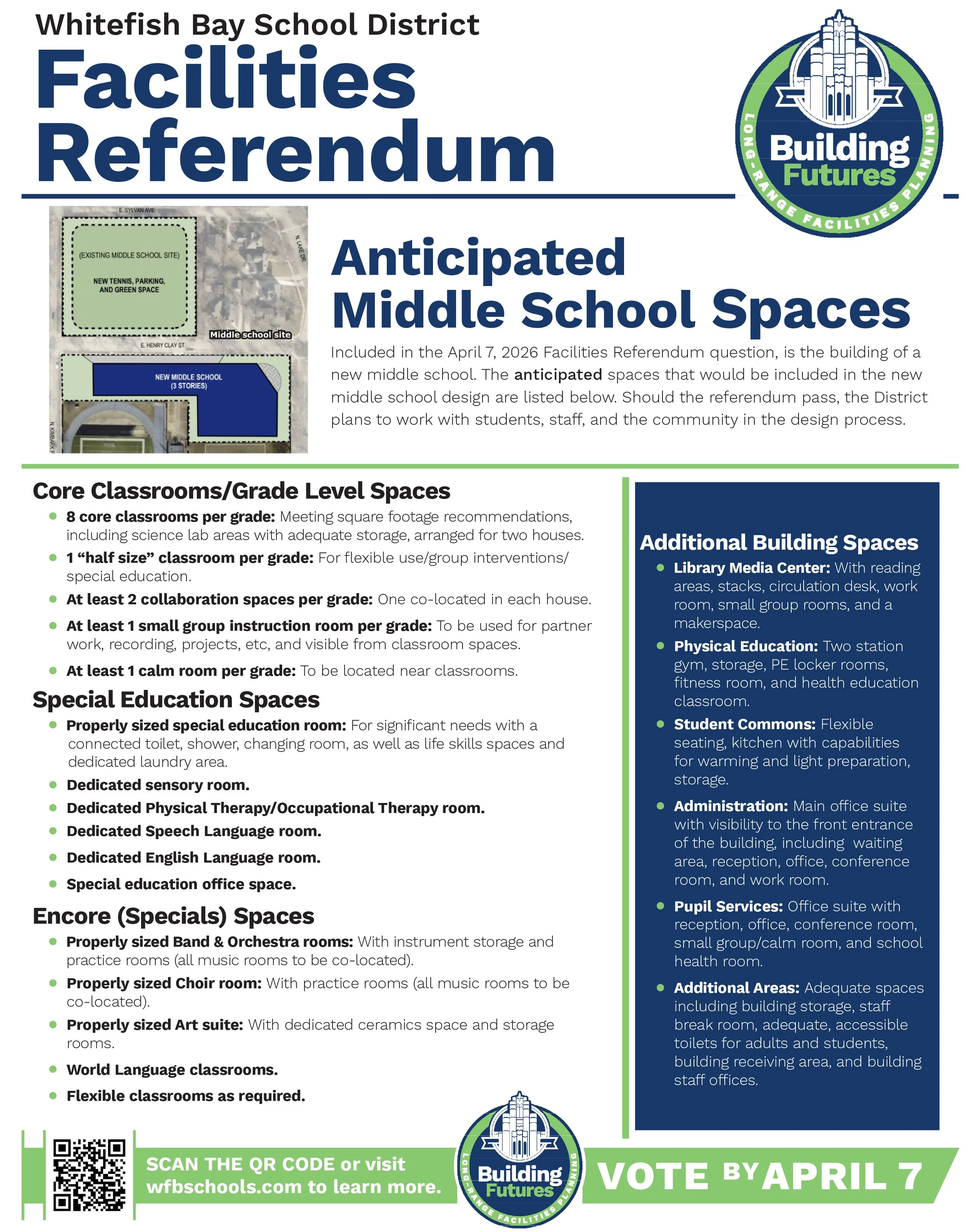
What Will Actually Be In the New Middle School?
What’s Going Into the Cost of the Middle School?
Directly from the District:
New Middle School
Building Cost: 128,000 sf x $458/sf = $58.6M
Hazardous Materials Abatement: 123,950sf x $16/sf = $2.0M
Existing Middle School Demolition: 123,950sf x $18.50/sf = $2.3M
Existing Site Restoration and Other Sitework Allocations: $4.7M
Total: $67.7M
Renovate In Place
Addition – New Construction: 48,500 sf x $458/sf = $22.2M
Renovation – Heavy: 91,450 sf x $345/sf = $31.6M
Renovation – Moderate: 8,500 sf x $284/sf = $2.4M
Façade/ Fenestration/Roofing/Structural Reinforcement/Restoration: $5.3M
Temporary Classrooms (Trailers) and Logistics = $1.1M
Hazardous Materials Abatement: 123,950sf x $16/sf = $2.0M
Existing Middle School Demolition: $0.7M
Site Restoration and Other Sitework Allocations: $2.5M
Total: $67.8M
The middle school cost estimates were developed using a cost‑per‑square‑foot modeling approach, based on a projected 128,000‑square‑foot facility and current market benchmarks of approximately $458 per square foot for building costs and $16 per square foot for hazardous materials abatement (for the full $474/sf noted previously). Both estimates incorporate inflation allowances within each individual line item, along with a 15% allocation for soft costs, including architectural and engineering fees, permitting, and furniture and equipment. In addition, the estimate includes an 8% allocation for both Owner contingency and Construction contingency. While the elementary school projects focus on targeted renovations with known footprints, the Middle School estimate represents a comprehensive "all-in" ceiling for new construction, ensuring that the referendum amount covers every phase from the initial demolition to the final specialized classroom equipment.
In terms of facility level, the budget targets a 'High-Durable/High-Performance' standard. This means prioritizing long-term energy efficiency and low-maintenance materials that will serve Whitefish Bay for the next 50 to 75 years, rather than a 'baseline' build that might require more frequent, costly repairs down the road.
Aside From the Infrastructure, How is our Middle School Performing?
Whitefish Bay Middle School is performing extremely well academically. Based on Wisconsin DPI report card metrics, the school ranks among the top middle schools (grades 6-8) in the state, with achievement higher than 99.5% of Wisconsin middle schools, strong student growth (92.9%), and strong outcomes for target student groups (95.6%).
Despite these results, staff continue to focus on improving instruction and supporting every student. Current priorities include closing achievement gaps, expanding small-group math instruction, using data-driven teaching cycles, strengthening special education co-teaching, and integrating social-emotional learning (SEL) into daily instruction.
These results reflect the dedication and expertise of the school’s teachers and staff. At the same time, strong academic performance does not mean the building itself no longer needs improvement. Teachers and staff have consistently shared that many modern instructional practices are harder to deliver in the current facility, and that they often have to work around the physical limitations of the building to support students effectively.
FAQ
-
Response from the District:
Prioritizing District needs involves a rigorous analysis of both educational impact and facility condition, and while all our schools require investment, the Middle School has been identified as the most pressing priority due to the compounding failure of its core infrastructure and its inability to support modern learning. Unlike the targeted HVAC or localized infrastructure updates needed at the elementary and high schools, which can often be managed through smaller, phased projects, the Middle School's challenges are systemic, involving non-compliant accessibility, failing mechanical systems, and a rigid layout that cannot be modernized through simple repairs. Should the referendum not pass, the Board would face the difficult task of diverting significant funds from our limited operating budget to "patch" a building that is functionally obsolete, potentially delaying the very elementary and high school improvements our neighbors are concerned about. Ultimately, replacing the Middle School is the most fiscally responsible "first move" because it addresses the District’s greatest liability while clearing the path for future, smaller-scale investments across our other campuses.
-
Response from the District:
This is a vital question for understanding the "Long-Range" part of our Facilities Plan. It gets to the heart of whether this is a one-time request or the start of a recurring cycle.
Is the Middle School unique?
Yes, the Middle School is currently in a unique category of "critical need." While all of our schools are aging, the Middle School faces a combination of factors that the other buildings do not: it is the most "landlocked" site, has the most significant student supervision and accessibility (ADA) challenges, and its core infrastructure is the closest to failure. Our middle school was originally constructed in 1918, during a time when long-term campus expansion was not part of the design approach. As a result, the building and site evolved incrementally over time, with additions responding to immediate needs rather than a comprehensive long-range plan, which makes modernizing the current footprint significantly less cost-effective than a new build.
What is the remaining useful life of the other schools?
In contrast, our high school and elementary schools, built in the 1920s and 1930s, were designed with greater consideration for future growth. Early conceptual planning identified where additions could occur and how those expansions would integrate with the original structure. That foresight has allowed those campuses to evolve more cohesively over the decades, and with the renovations included in this referendum, their "useful life" can be extended by several decades.
The Goal of This Referendum: By allocating $67.9 million for district-wide renovations, we are specifically targeting the "internal organs" of the High School and Elementary Schools (HVAC, plumbing, electrical, and roofing).
Extending the Horizon: When we replace 30 plus year-old systems (i.e. complete HVAC systems, not just some of the components) with modern, high-efficiency systems and update the electrical and plumbing systems to meet current demands of our schools, we effectively "reset the clock" on the infrastructure of these schools. With proper maintenance, these structures can remain functional and "future-ready" for another 30 to 50 years.
Should we expect another new building soon?
The current Long-Range Facilities Plan does not project the need for another brand-new school building in the foreseeable future. The strategy is to "Build New" where the current structure is no longer viable (the middle school) and "Renovate Deeply" where the bones of the building remain strong (High School and Elementary). This balanced approach is designed to be a "generational fix," stabilizing our facility needs so the District can return to its primary focus of student learning for decades to come. -
Answer from the District:
We understand that the War Memorial and the green space at Armory Park are deeply woven into the fabric of our Village. It is vital to clarify the District’s commitment to these assets and our ongoing collaboration with the community.Honoring the War Memorial
The District has been in direct, ongoing communication with the Friends of Armory Park. These discussions have been characterized by a shared goal: ensuring the Memorial’s mission of honoring our veterans is protected and preserved for the next century.
Collaborative Process
We have met with key members of the organization who represent the vision of those who established the site. Their stated position is one of support for the new Middle School, provided the District follows through on the promise to integrate, protect, and enhance the Memorial.
Preservation Strategy
The District is committed to not paving over the Memorial. Instead, the design process is centered on an "integration approach." This means working with architects and veterans’ representatives to ensure the Memorial remains a prominent, accessible, and dignified feature of the landscape, either by maintaining it in its current location with enhanced surroundings or by creating a dedicated, reflective space within the new site design that elevates its prominence.
-
Answer from the District:
Green Space & Environmental StewardshipWe hear the concerns regarding the finite nature of our parkland. The District’s strategy is a "net-zero" approach to green space, utilizing the land swap to create a better, more functional park system for the Village.
Comparable Size
We can confirm that the design plan aims to create a reallocated green space at the current Middle School site that is, at minimum, comparable in total square footage to the open space utilized at the Armory site. Our goal is to shift from the current "fragmented" layout to a single, contiguous block of green space, which provides far greater recreational and environmental value.
-
Answer from the District:
The assertion that 25 trees will be cut down is an estimate that does not account for the comprehensive landscape replacement plan. If the referendum passes, the next phase is a detailed site survey. The District’s goal is to maximize the retention of existing mature trees. For any trees that must be removed, the District will implement a replacement ratio (typically planting multiple new trees for every mature tree removed) to ensure our long-term canopy remains robust. At this point, we also do not know if all the trees will need to be removed with the construction of a new Middle School and there could be some trees that remain within the footprint.
For more questions, please check out our main FAQ page.
