Full Video Recording - 6/10/2026
Main Takeaways
The board agreed on the format for the focus groups. Short introduction, small tables to discuss specific questions, and formal follow-up combined with informal board conversation.
The three questions the board agreed on for the focus groups are as follows. There will be additional handouts for reference during the discussions. Every person will have 2 minutes for their initial response to each question.
Question 1: Please share why you voted the way that you did on the referendum question on April 7, 2026. If you did not vote, please share your perspectives.
Question 2: What stands out to you as the greatest needs and constraints across our facilities.
Question 3: Please share your thoughts on a tax impact that ranges from $90M to $125M.
The board reviewed current enrollment numbers at the elementary schools and is looking at options around low 4k and high fifth-grade numbers at Richards.
Full Notes
*These are unofficial notes from the video recording of the meeting. AI was used to create these notes. They were reviewed by a community member.
The meeting opened with student presentations related to career readiness. Then the board discussed logistics surrounding the upcoming focus groups. This discussion was outlined in this memo. The meeting ended with an enrollment update for the elementary schools.
Student presentations connected career readiness, design, and the arts
The meeting began with the district’s annual Education for Employment / Academic and Career Planning report. Administrators used the time to show how the work appears in student experiences rather than simply walk through a document.
At the middle school, staff described the Design Challenge class as a continuation of skills students build in earlier Project Lead the Way coursework: technical drawing, 3D modeling, collaboration, and the design process. The class is built around real challenges from community partners; examples include adaptive devices for hospital patients, enrichment tools for zoo animals, and accessibility-related prototypes.
Three middle school students then described their own projects - an adjustable dog feeder, a device to help a stroke survivor, and a temperature controlled storage prototype. The students connected the class to engineering, trades, manufacturing, math, physics, writing, communication, teamwork, and problem-solving.
The high school example shifted to the art program. A counselor introduced a senior, Jay Barry McIntyre, who had taken 13 art classes across middle and high school, including 3 AP art classes. In a conversational format, Jay described how art had become central to her school experience, how her work had gained more meaning over time, and how AP portfolios required her to build sustained inquiry around a theme or question.
Board members responded by highlighting how both presentations illustrated that “career readiness” is not limited to traditional job training. The discussion emphasized that arts, design, problem-solving, communication, and technical skills all contribute to preparing students for life beyond school. One board member noted that the timing was especially relevant because the board would later vote on the art and music curriculum renewal.
The board reviewed how the Armory memorial could fit into a possible middle school site
Before discussing the focus groups, the board heard from architect Nick Kent about possible ways to incorporate the Armory memorial into a future middle school site. The village had asked the district for more direction as part of work toward a memorandum of understanding.
Kent emphasized that this is NOT a design proposal, but a way to think about where memorial elements might be incorporated into a new middle school. He described three possible exterior areas: the northeast corner facing Lake Drive, the east face of the building, and the south face near the lacrosse field (which could provide space for gatherings on Memorial Day and Veterans’ Day). Together, those areas could create a more connected and extended memorial experience using symbolism, history, storytelling, and educational elements. He also noted that interior community spaces might support memorial-related events or programming.
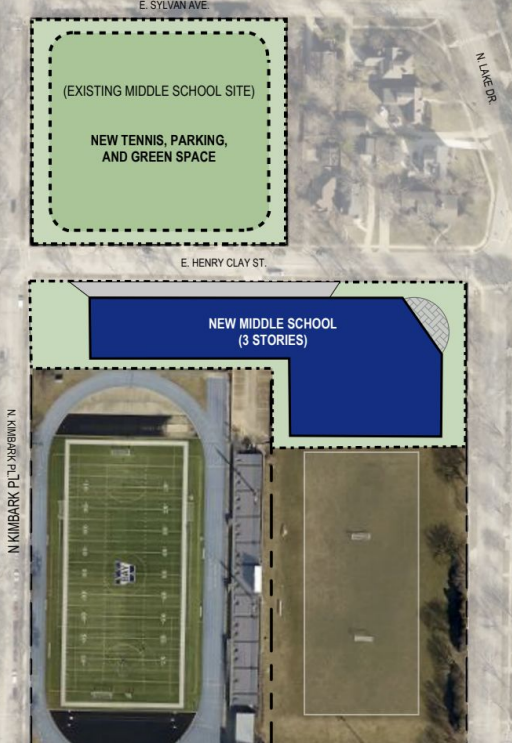
Board members appreciated having something more concrete to react to, especially because some residents had felt uncertainty during the first referendum when the district said the memorial would be preserved in some form but did not have a clear image of what that could mean. At the same time, members were cautious about over-designing before talking with the people most connected to the memorial.
A key unresolved question was whether the memorial should be integrated into the building, placed on reallocated green space, or possibly involve both. Several members said they could not answer that without hearing from the memorial group and other stakeholders. Administrators explained that the village needs some direction for the MOU, ideally by around the end of August, in parallel with any decision about a November referendum question.
Focus group format: introduction, structured tables, and public reporting
The board then turned to the upcoming focus groups. Members first discussed whether the evening should begin with a presentation or a short introduction. The consensus was to keep the introduction brief, with the superintendent opening the session and board members being introduced so residents know they are present and listening.
Administrators described a structure with tables of roughly six to seven people, leaving room for walk-ins. Each table would have a facilitator/note taker, with board members rotating among the tables. Each participant would get an initial two minutes to respond to each question before the table opened into broader discussion. Notes would be synthesized afterward, shared with the board, emailed to participants, and posted publicly along with the number of participants.
The board appeared comfortable with that structure, including the idea that members could rotate between tables or stay with one table for a full question to listen more deeply.
Focus group questions: why people voted, what needs they see, and tax impact
The first proposed question asked residents to share why they voted the way they did on the April referendum, or to share their perspective if they did not vote. Board members seemed broadly aligned that this question was essential.
The board wrestled with whether to ask residents about a possible future November referendum and whether to provide information about previous project costs. There was discussion how to accurately give information without making the focus groups feel like a presentation about a new proposal. Members said the facilities needs identified before the April referendum had not disappeared, but how those needs might be organized, sequenced, or scaled could change. The distinction that emerged was between needs and projects.
The board agreed to using a reference sheet that would describe the needs and costs included in the April referendum; this was to help ground the discussion in the still outstanding needs. They also aligned toward asking residents what they understand to be the greatest needs and constraints across district facilities. That framing would allow the board to learn how prior information had been received.
For the third question, they discussed asking about tax impact. Some members wanted a direct question about what investment level residents might support, possibly using ranges or examples. Others worried that a tax-tolerance question could become too future-oriented for a listening session focused on understanding the failed referendum. Eventually, members seemed to support asking about tax impact in some form, especially if it helped contextualize qualitative feedback, while also recognizing that a survey may be a better place to gather broader quantitative data.
How to end the focus groups: follow-up communication + informal conversations with board members
The board considered several ways to conclude the focus groups: immediate synthesis of themes, a board panel, or follow-up communications after staff had time to review the notes. Administration preferred follow-up communication.
The reason was that 16 tables could end at different times, making immediate synthesis difficult and potentially inaccurate. A board panel also risked shifting the session from listening into telling or debating. Several members agreed that if the district wants to be careful and fair with what it heard, it should take time to synthesize the feedback and report back clearly.
There was also a concern that a purely written follow-up could feel filtered. Residents may wonder whether their questions or comments were left out. Others said residents are asking for a way to interact with the board as a whole, because traditional public comment does not allow two-way conversation.
The compromise was to end with follow-up communications as the formal process, but have board members remain available afterward for informal one-on-one or small-group conversations. Members also acknowledged that the broader need for public dialogue may not be solved by these two focus groups alone. Several suggested the board may need to consider additional formats later, especially if a specific referendum proposal moves forward.
The board supported adding a community survey
The board then discussed whether to add a survey. There was clear support for doing so. Members noted that the focus groups, even with strong attendance, would reach only a small fraction of the community. A survey would provide broader quantitative input and could be compared with the qualitative feedback from the focus groups.
One member noted that a previous concern was that a survey could feel like it was driving the process. This time, the survey would follow or accompany more direct listening, which made it feel more appropriate as one data point rather than the entire engagement strategy.
Administrators said the Donovan Group could prepare a survey draft quickly, but the timeline would be tight: the board would need to approve the survey at the next Wednesday meeting, with individual board feedback gathered before then and revisions made in time for a vote. The district was also preparing a postcard with a QR code to send to the community.
The survey would be web-based, with a paper option available at the district office if needed. Unlike the prior School Perceptions process, the postcard would direct residents to a QR code rather than mailing individual survey links. Administrators said IP addresses could be monitored to help detect repeated submissions, and board members emphasized that the district should clearly communicate that multiple adult residents in the same household may each complete the survey.
Donations, personnel, curriculum, library plan, Chapter 220, and policy approvals
After the facilities discussion, the board moved through items of regular business.
The board approved donations totaling $38,181.80, bringing the yearly donation total to $296,938.52. Donations included support for staff appreciation, girls lacrosse, boys track and field, girls softball, boys tennis, and aviation club.
The board approved the personnel report, including one 4K teacher resignation and one new special education hire at the high school. It also approved authority to issue contracts over the summer to fill vacancies.
They approved the art and music curriculum renewal and design report and also approved the library plan. These were presented in the last board meeting on 5/27.
The board then approved the 2026–27 Chapter 220 interdistrict agreement. Members noted that the program is sunsetting, which several described as unfortunate. And finally, they also approved first-read changes to Policy 528 on staff-student relations.
Enrollment and staffing: low Richards 4K enrollment and concern over fifth-grade class size
The final substantive discussion was an enrollment and staffing update. Administrators said the district will continue updating through summer and fall, especially around elementary enrollment. The current 2026–27 anticipated enrollment includes four added sections across Richards and Cumberland to address class-size needs.
Administrators reported lower-than-expected 4K enrollment there, with 56 students compared with 81 at Cumberland. Because 4K is optional and enrollment is less predictable, the district tends to be conservative about reducing or adding 4K sections too quickly.
There was also concern that the Richards 4K average could be very low, while Richards fifth grade could average around 27 students. Several members said 27 is too high for elementary class size, especially given the board’s stated commitment to historically smaller elementary sections.
The discussion turned to the impact of reducing 4k sections to help potentially increase fifth-grade sections. Administrators explained that reducing Richards 4K from four sections to three would likely require moving a Richards teacher to Cumberland and shifting other staff around. It would also not save the cost of a full teacher because 4K staffing is half-day. Adding a fifth-grade section would be more complex than simply adding one classroom teacher because it affects encore staffing and FTE allocations.
The board asked administration to return with options and the fiscal impact of adding a section, potentially offset by changes elsewhere. Members acknowledged both the class-size concern and the district’s fiscal responsibility.
Overall Tone of the Meeting
The meeting felt like a shift toward process design. The conversation focused on building the next round of engagement: focus groups, survey design, public reporting, and the timeline for possible November action.
The final enrollment discussion brought the meeting back to day-to-day district management. It underscored that while referendum planning is the dominant public issue, the board is also managing immediate operational planning around staffing, class size, enrollment shifts, and budget limits.
Public Comment
No public comments were made at this meeting.
