Full Video Recording - 7/15/2026
Main Takeaways
The district’s facilities survey had already drawn 1,164 responses, but board members were less interested in simply reaching a statistical minimum than in knowing if all demographics were being adequately represented. The survey closes July 31, with results discussed at the August 12th board meeting. Take the survey here!
The board reviewed different paths for the Middle School, including one new option: approximately $21 million to maintain infrastructure systems only, $67.7 million for a new building (the option from April), or $67.8 million for a comprehensive renovation. A new variation could preserve the Armory Memorial in place ($67.3 million), but it would reduce the adjacent lacrosse field.
3. The district recommended against spending approximately $220,000 on a temporary High School HVAC controls upgrade. It could take six months to a year to complete, would not replace aging equipment, and would likely be removed during a future comprehensive replacement. This decision may be revisited depending on the result of the November referendum.
4. After a long discussion about elementary class sizes, the board directed the district to post one additional upper-grade teaching position. The assignment will remain flexible while enrollment changes are monitored. The district will keep its current 4K sections and continue watching whether another teacher may be needed. This will be discussed again in August.
Important Dates
The facilities survey remains open through July 31.
Targeted sessions with Armory Memorial representatives and Middle School neighbors will take place next week (July 20 and July 21).
The next board meeting is August 12. They will be discussing focus group and survey results. They will also look an enrollment again.
August 25 - referendum question must be filed by this date to appear on the November ballot.
The district’s annual meeting is scheduled for September 2.
Full Notes
*These are unofficial notes from the video recording of the meeting. AI was used to create these notes. They were reviewed by a community member.
The meeting started with updates on focus groups and survey results. They then continue to discuss options for the Middle School - reviewing some of the previous options and looking at one new variation. The board reviewed the HVAC issue as discussed last month. And the meeting closed with a discussion on elementary school enrollment.
Focus Group and Survey updates
The meeting began with an update on the June/July facilities focus groups. Three themes emerged most strongly from the June 16 session: concern about taxes and fiscal responsibility; broad agreement that the Middle School has serious shortcomings, paired with disagreement over renovation versus replacement; and distrust or uncertainty surrounding the Armory Park location, the level of architectural detail, and how previous options were evaluated. The July 14 themes were still being compiled.
Administrators noted that the session had been moved into the Middle School basement because of the heat—an immediate example of the building conditions under discussion.
The Donovan Group reported that the facilities survey had received 1,164 responses, far exceeding its baseline target. Of those, 451 - or 38% - were from non-parents/non-staff. Board members pushed back on measuring success primarily by the number of responses given the goal to reach as much of WFB as possible, particularly residents who are not regularly connected to the schools. Members requested demographic information about the respondents and asked whether the survey was successfully reaching people who voted “No” in April. Donovan was hesitant to release actual answer patterns while the survey remained open but agreed that respondent demographics could be shared.The practical concern was that a large sample does not automatically resolve whether the sample reflects the electorate.
The conversation turned to what the board should receive from the focus groups. Some members worried that reducing hours of discussion to three themes could leave out unusual but valuable ideas. They wanted to know not only what participants repeated most often, but also whether someone had raised an option/concern the board hadn’t previously considered. Others cautioned against overemphasizing isolated comments or asking administrators to spend substantial time processing every handwritten note.
The discussion also exposed an important methodological point: focus groups are intended to reveal reasoning and nuance, not measure what a majority of the community believes. The survey is the broader quantitative tool.
Administration agreed to expand the summaries beyond three themes where useful. The board decided to wait until August 12—when it expects to have the survey results and combined focus-group findings—before holding a larger discussion about what it has heard.
Two additional focus groups are scheduled for next week - Armory Park specific (July 20) and Middle School neighbors (July 21). The survey will remain open through July 31, with analysis presented August 12.
Previous Three Middle School options
PRA (architects) and C.D. Smith (construction management) then presented more detailed information on the principal Middle School approaches discussed in the lead up to the April vote.
Maintenance-only — approximately $21 million. This option would replace or address identified building systems and maintenance needs but leave the basic layout and functionality substantially unchanged. The building would receive a renewed infrastructure backbone, but its spatial limitations, circulation patterns and learning environment would remain.
New construction — approximately $67.7 million. This was the approach included in the April referendum. The estimate includes about $45.2 million for the building itself, along with site work, demolition of the existing school, restoration of that property, professional services, furnishings, contingencies and inflation. The consultants again emphasized that the building has not been designed; the diagrams developed so far are test fits used to establish whether the proposed program can fit on the site and to estimate costs.
Comprehensive renovation and expansion — approximately $67.8 million.The existing building would be stripped largely to its structure, expanded and reorganized to provide approximately the same educational functions as a new school. Mechanical systems, interiors and most spaces would be replaced or substantially changed.
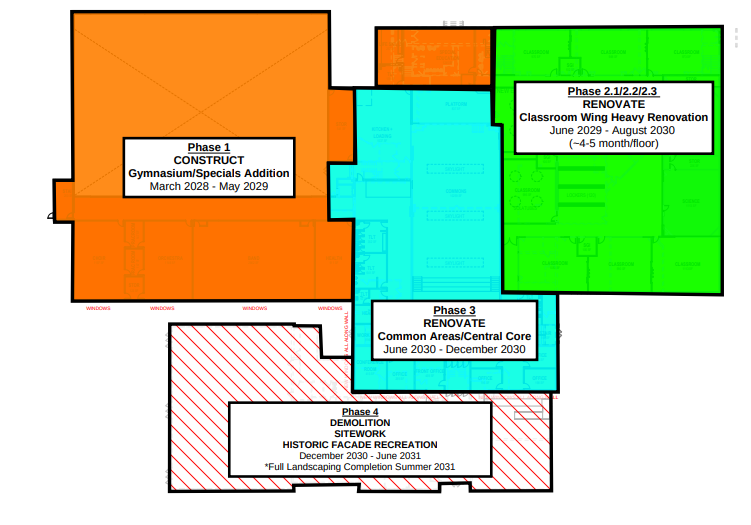
The renovation would also create major operational disruption. The consultants projected a roughly three-year phased project. An addition would first be constructed to provide temporary classroom space, after which students would move between sections as the existing building was renovated. Temporary classrooms would occupy gym space, leaving the Middle School without a functioning gym—and most likely, without a library—for much of the multi-year project. The school would lose most of its outdoor recreation space throughout the process. Henry Clay Street would likely close for construction staging, and portions of the lacrosse field may also be needed. Temporary classroom trailers were not included in the estimate and could add significant costs and regulatory requirements.
The architects said the final renovated building could solve many accessibility problems and would perform similarly to a new building mechanically. But preserving an existing structure often produces a less efficient footprint because designers must work around columns, walls and other fixed conditions. They cited prior projects (in Wauwatosa) where comprehensive renovations ultimately cost more than comparable new buildings.
A new variation to preserve the Armory Memorial
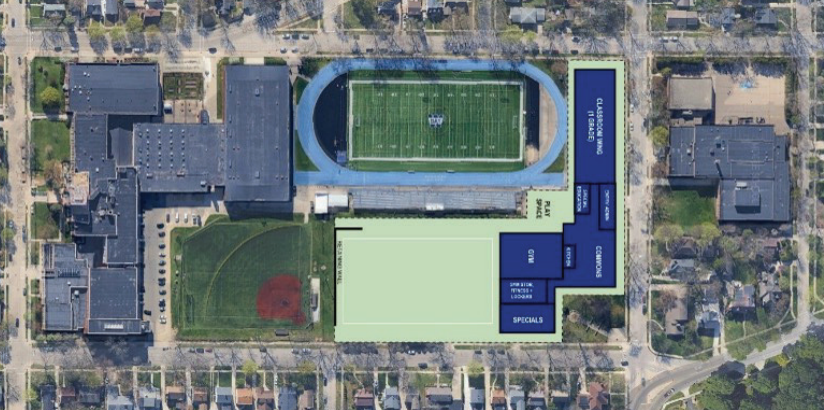
The consultants presented a modified new-construction concept that would preserve the Armory Memorial in its current location - a three-story school shaped around the memorial and shifted farther south.
The concept is physically possible, but it has additional hurdles and tradeoffs. It would require additional Village-owned land, shorten the lacrosse/soccer field so that it would no longer be regulation length, and require a retaining wall near the softball field. Construction could also encounter old Armory foundations or contaminated soil. The building would sit relatively close to the memorial, raising a question about whether the memorial could retain an appropriate sense of prominence and dignity.
The existing Middle School would still be removed, allowing that property to be converted into parking, tennis courts and green space. Board members saw potential benefits in preserving the memorial exactly as it is, but also recognized the loss of athletic space and the visual relationship between a three-story school and the memorial. The lacrosse field is currently used for lacrosse and JV1/JV2 soccer; in this option - practices could still occur but games would need to be moved to the football field.
No one proposed adopting this concept. It was presented as another data point—not a new preferred plan.
Reconsider the old options—or better explain them?
The Middle School presentation led to a broader discussion about transparency. Some members said residents still do not understand why other alternatives, such as Lydell, were rejected. If the board is publishing new analyses, they argued, it should put the earlier options into the same consistent format so residents can follow the decision path.
Other members opposed reopening two years of facilities work. They distinguished between reconsidering every option and documenting why each one had previously been set aside.
The emerging direction was to revisit the earlier Facilities Advisory Committee materials and create clearer, comparable explanations—particularly for Lydell—without treating every former option as newly active.
Engagement after a possible referendum question
Looking ahead to the fall, board members suggested a different format from the previous referendum information sessions: shorter presentations, more time for direct questions, and answers from administrators, architects and financial experts rather than relying primarily on board members. They also recommended frequently updated social-media questions and answers, short videos about specific building problems, teacher explanations of how facilities affect education, and meetings at varied times.The board did not add another formal community-wide event before its August discussion. Most members felt that two general focus groups, the community survey and the two targeted sessions provided enough opportunities for this stage. They did, however, ask for an end-of-July update thanking residents, reporting participation and explaining what happens next.
The district will not pursue a temporary High School HVAC upgrade
Administrators recommended taking no immediate action on a proposed approximately $220,000 upgrade to portions of the High School’s HVAC control system (this was discussed in the last board meeting).
The work would improve controls but not replace the old mechanical equipment. Siemens estimated that even with an immediate purchase order, the project could take six months to a year. If a comprehensive HVAC replacement moves forward as part of a new referendum, the new controls could not be reused and would be removed after only a short period of service.
For now, facilities staff believe they can continue managing the system manually. That may mean individual rooms becoming excessively warm or systems becoming stuck at inefficient settings, but safeguards make a complete loss of heat less likely. The recent heat wave illustrated the larger problem. Some spaces—including Memorial Gym, the auditorium and the fieldhouse—became difficult or unsafe to use, forcing activities to be cancelled or moved.The decision avoids spending money on a likely temporary fix. The board can also revisit the issue after a November referendum if a comprehensive solution is not approved.
Budget and Armory Park agreement
During the regular business meeting, the board approved the preliminary 2026–27 budget. Enrollment, state aid and other figures will continue to change before the final levy is established in October. The district’s annual meeting is scheduled for September 2.
The board also extended the Armory Park shared-use agreement with the Village for approximately a year and a half. The district does not own the memorial property or adjacent athletic field, but it uses and maintains much of the area under a 20-year agreement that is now expiring.Rather than renegotiating a long-term arrangement, the district and Village will temporarily continue the existing terms. Administrators emphasized that this action only governs use of the field and park; it does not approve a land exchange or future construction.
Elementary class sizes force a budget-versus-program tradeoff
The final major discussion concerned elementary enrollment. Cumberland K4 is currently about 15 students above last year’s level, while Richards K4 is down nearly 30. The district has already added four elementary sections for the coming year, largely to protect class sizes in the younger grades.
Administrators identified several upper-grade cohorts that remain close to 27 students per classroom, particularly Cumberland third grade and Richards fifth grade.
The issue was not simply the cost of another classroom teacher. Adding sections means changes to common planning, intervention schedules, and requires additional fractions of art, music and physical-education positions. Those small part-time assignments can be difficult to hire, and available rooms are limited. The candidate pool for classroom teachers is also smaller in July than it was during the spring hiring season.
Administrators initially recommended making no further changes. They said smaller classes are desirable but argued that strong teachers, intervention systems and coordinated grade-level teams also affect student experience. But several board members remained uncomfortable beginning the year with six classrooms of 27 students. They pointed to prior parent complaints and to the district’s stated commitment to small classes. Others wanted to know what would be cut to pay for a second new teacher and warned against treating operating reserves as a recurring funding source.
The preliminary budget includes room for one additional section while remaining balanced. A second would require another reduction, new revenue or deficit spending.The board ultimately directed administrators to advertise one upper-grade elementary position without yet assigning it to a particular grade or school. That allows the district to begin recruiting while watching enrollment over the next several weeks. Current 4K sections will remain unchanged despite a particularly small Richards cohort, partly because teachers are already under contract and enrollment can change quickly. The district will continue monitoring whether a second upper-grade section is necessary and will provide more information about its financial impact in August.
Overall Tone of the Meeting
The facilities portion was exploratory and sometimes cautious. The board is gathering substantially more information, but it has not yet translated that information into a defined referendum recommendation.The class-size discussion was more immediately decision-oriented. It exposed a familiar tension between the educational value of smaller classes and the financial, staffing and scheduling consequences of adding additional positions. Unlike the facilities discussion, it ended with a concrete near-term direction.
Public Comment
If you’d like to review public comments, please see full video. Comments start at 1:42:00
